§ 14a EnWG explained
Dimming, grid fees, the Steuerbox: what applies to new heat pumps and wallboxes in Germany – in nine chapters, every statement with its source.
Video
§ 14a EnWG einfach erklärt
5:21 · Video coming soon
If your heat pump or wallbox has been in operation since 2024, your grid operator may dim it in certain cases. But how far? And why does your installer ask about an energy management system (EMS) when it comes up?
This page is the written version of the video above, chapter by chapter. It is translated from the German original; the pictures come from the German film, so their labels are in German. German legal terms are kept where they are the official name. Every statement names its source; everything is as of 10/2026.
Source: BNetzA, consumer FAQ (introduction)
Chapter 1: Why does § 14a exist?
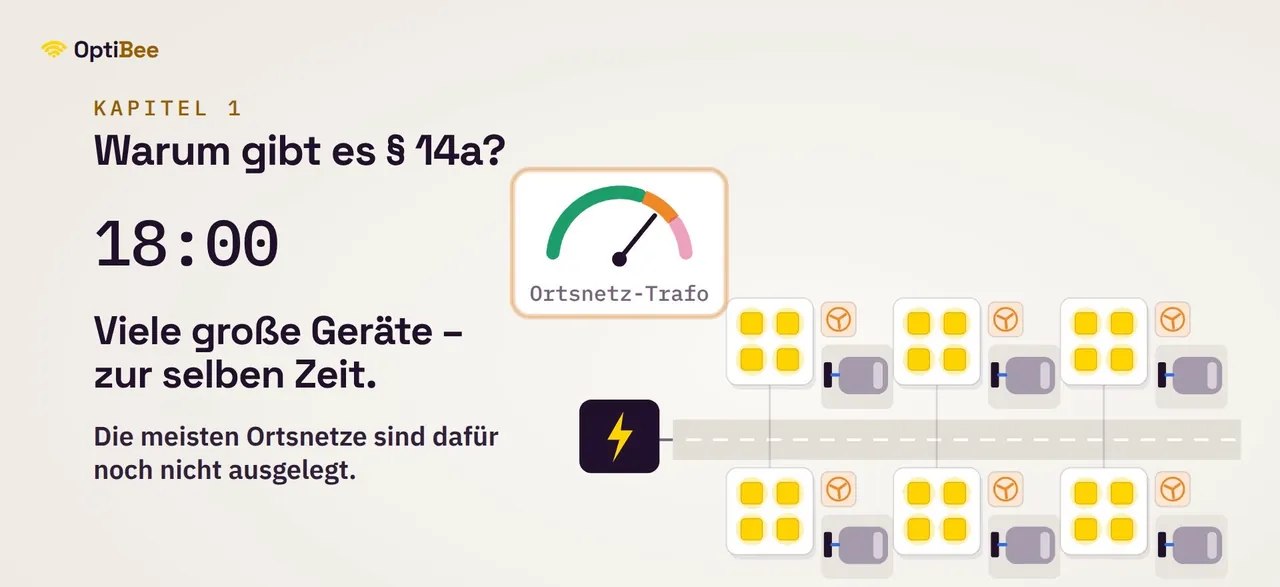
Heat pumps and wallboxes need a lot of power – and often run at the same time. Most local low-voltage grids (Ortsnetze) are not yet designed for so fast a ramp-up.
Source: BNetzA, consumer FAQ (introduction)
Chapter 2: What is the deal?
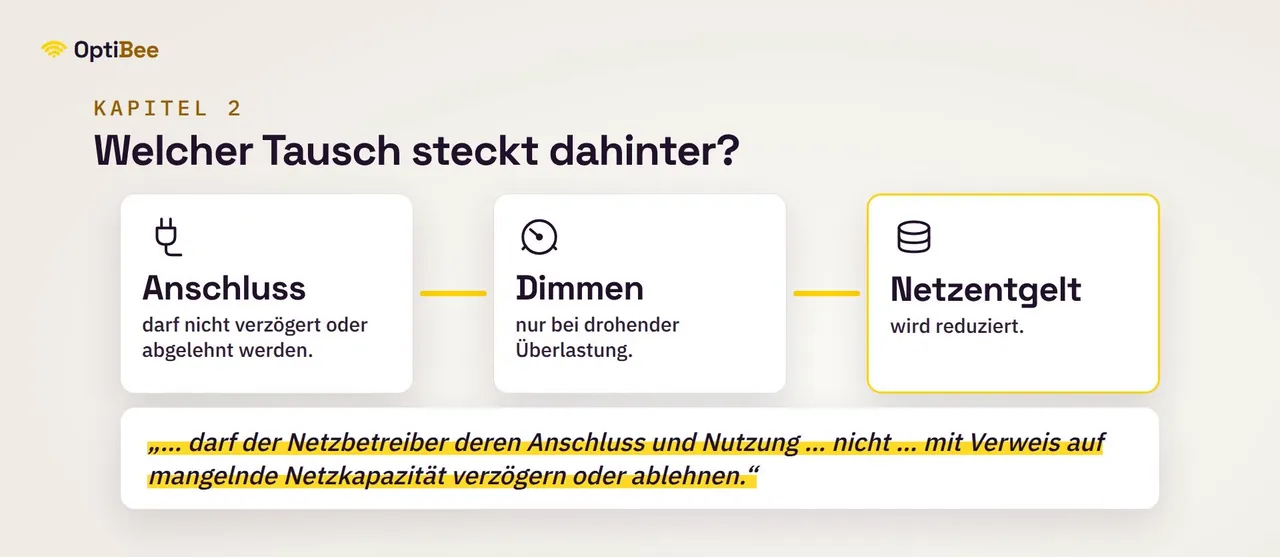
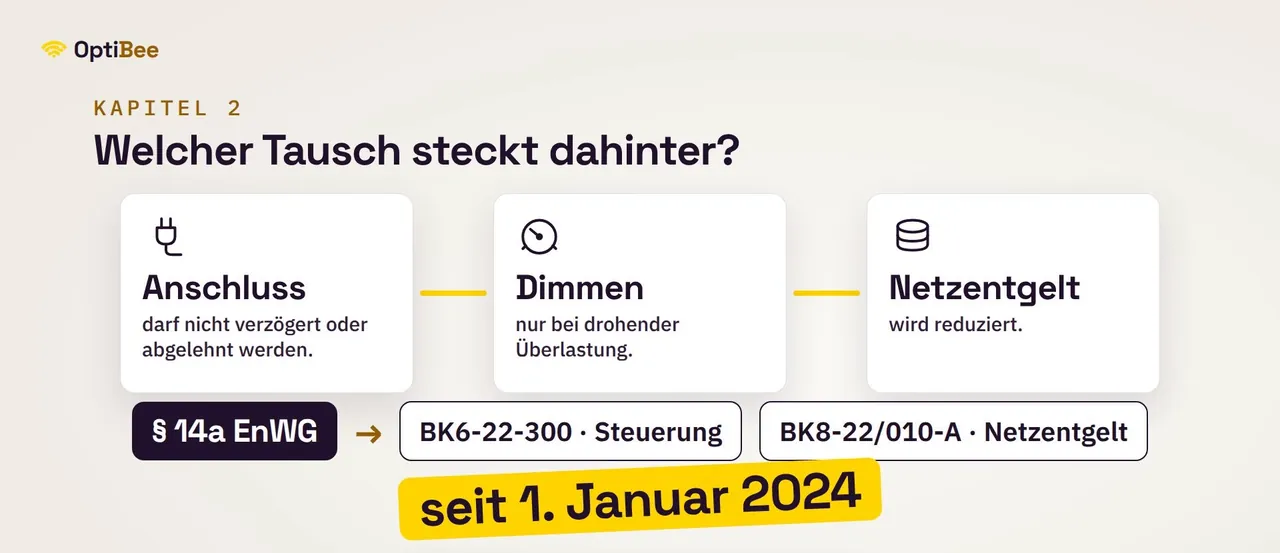
§ 14a is a deal in three parts:
- Connection. Your grid operator may not delay or refuse the connection of your heat pump or wallbox because grid capacity is short.
- Dimming. In return it may dim them when the grid is threatened with overload. Until the end of 2028 there is a transitional rule for this, see chapter 4.
- Grid fee. For this you pay a lower grid fee (Netzentgelt).
In the Bundesnetzagentur's own words:
„… darf der Netzbetreiber deren Anschluss und Nutzung … nicht … mit Verweis auf mangelnde Netzkapazität verzögern oder ablehnen.“
(… the grid operator may not … delay or refuse their connection and use … citing a lack of grid capacity.)
BNetzA BK6-22-300, Annex 1, No. 5
The Bundesnetzagentur set the rules on the basis of § 14a EnWG, in two determinations (Festlegungen): BK6-22-300 covers control, BK8-22/010-A the grid fee. Both have applied since 1 January 2024.
Source: BNetzA BK6-22-300, Annex 1, No. 4.1, 5, 10.5 and 11 · BK8-22/010-A, Tenor 7 · § 14a (1) EnWG
Chapter 3: Who is affected?
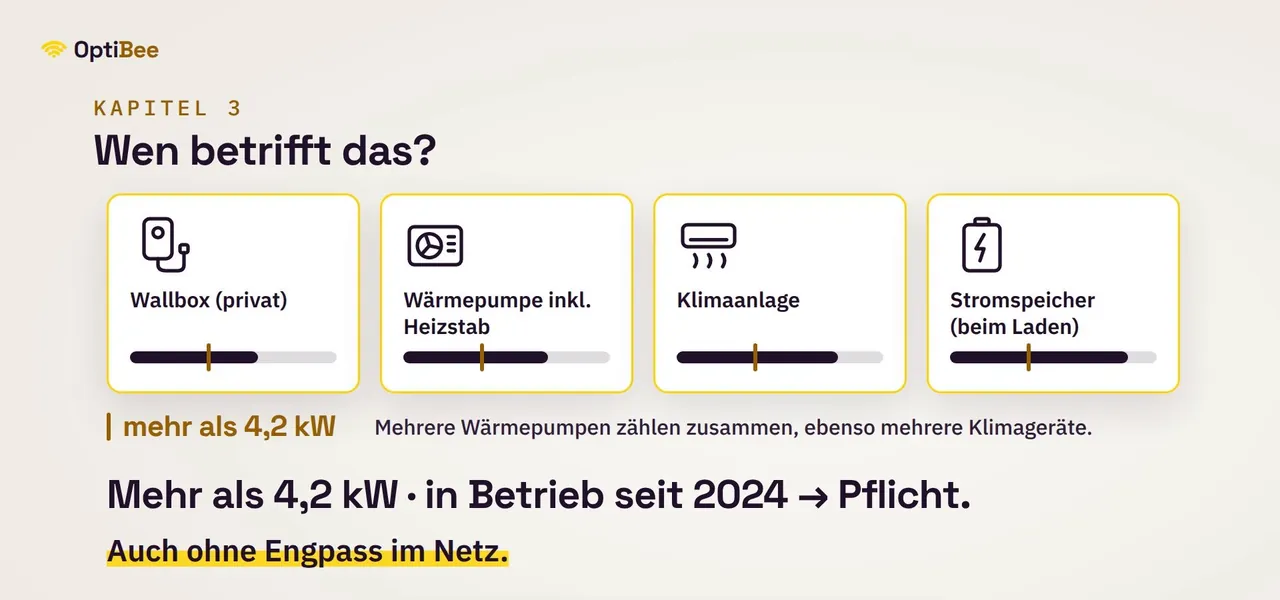
On the low-voltage grid, this covers:
- private wallboxes,
- heat pumps, including heating rods,
- air conditioning,
- battery storage, while it charges,
each with more than 4.2 kW. Anyone who put such a device into operation since 2024 is included. It is mandatory, even if your grid never gets tight. Several heat pumps are added together, and so are several air-conditioning units.
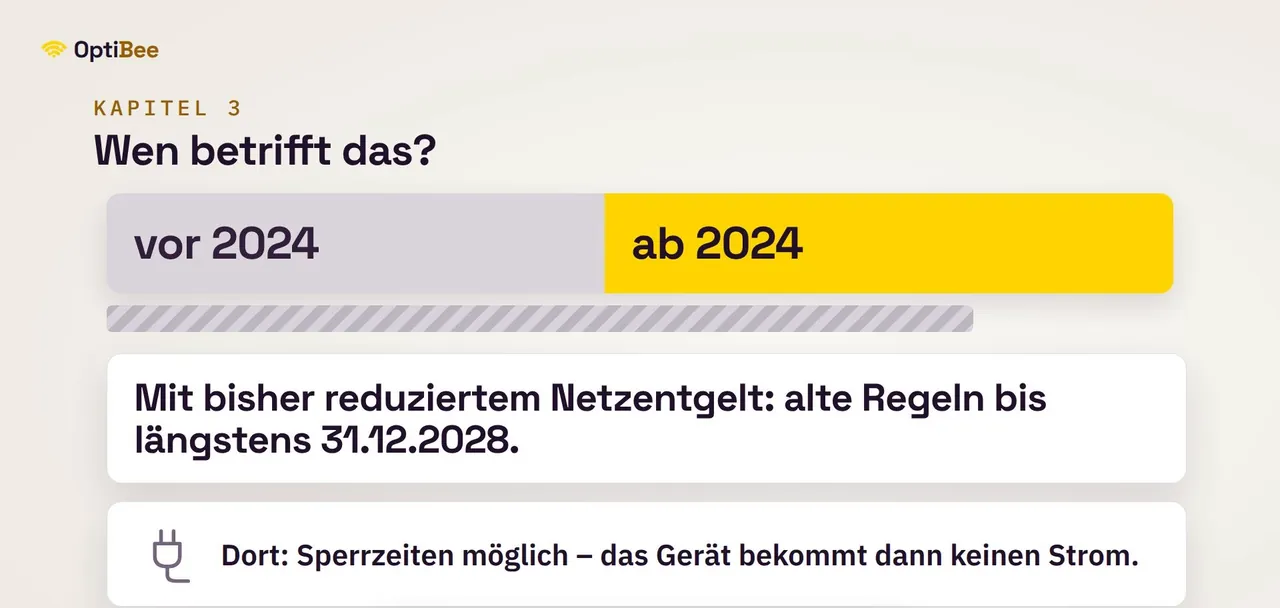
Older devices that already received a reduced grid fee may keep running under the old rules – until 31.12.2028 at the latest. Under those old rules the grid operator may interrupt the supply at blocking times (Sperrzeiten); the device then gets no power.
Source: BNetzA BK6-22-300, Annex 1, No. 2.4, 3.1, 3.2 and 10.1 · consumer FAQ (existing installations)
Chapter 4: How far may the grid operator go?
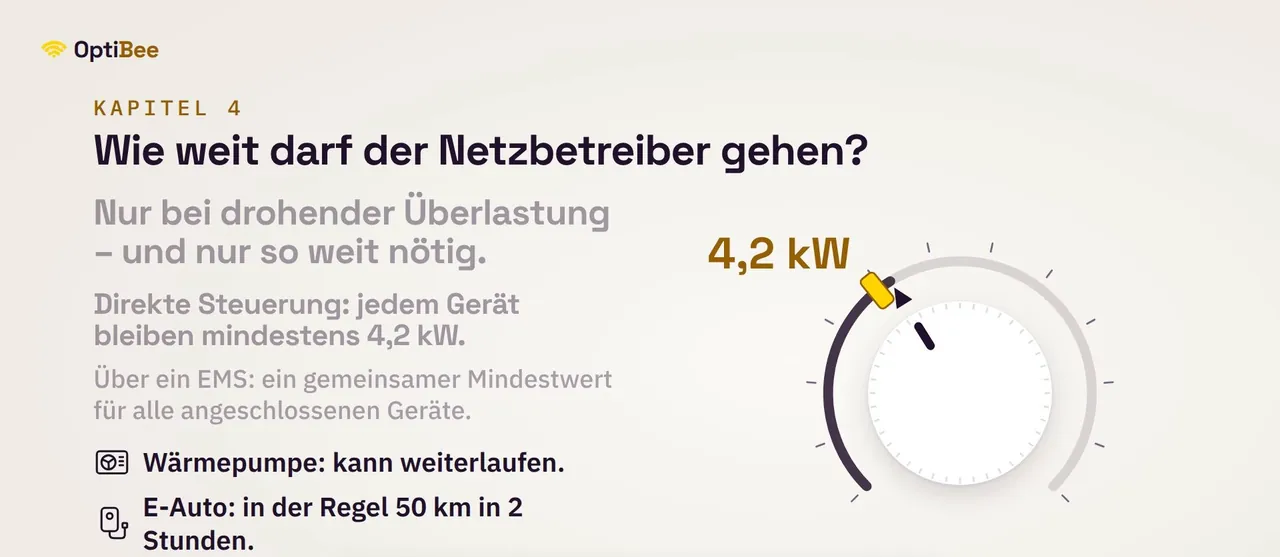
The grid operator may turn controllable devices down only when overload threatens, and only as far as necessary.
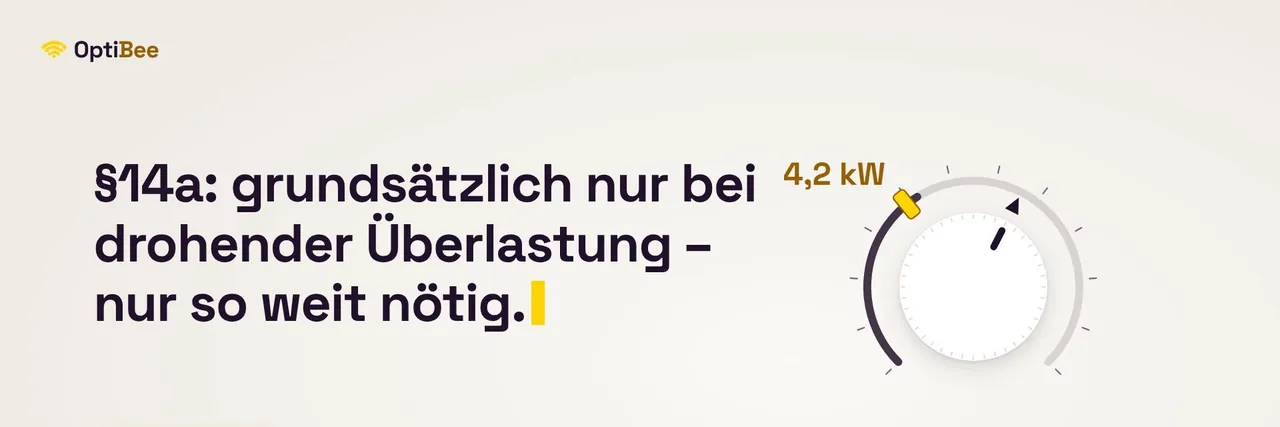
- Direct control: every device keeps at least 4.2 kW.
- Via an EMS: one joint minimum applies to all connected devices.
Transition until the end of 2028: where grid measurement data are missing, it may also dim preventively when overload is expected – at most 2 h a day, at most 24 months per grid area, at least 4.2 kW (BNetzA BK6-22-300, Annex 1, No. 10.5).
What does 4.2 kW mean? A heat pump can keep running on it, and an electric car usually charges enough for 50 kilometres in two hours.
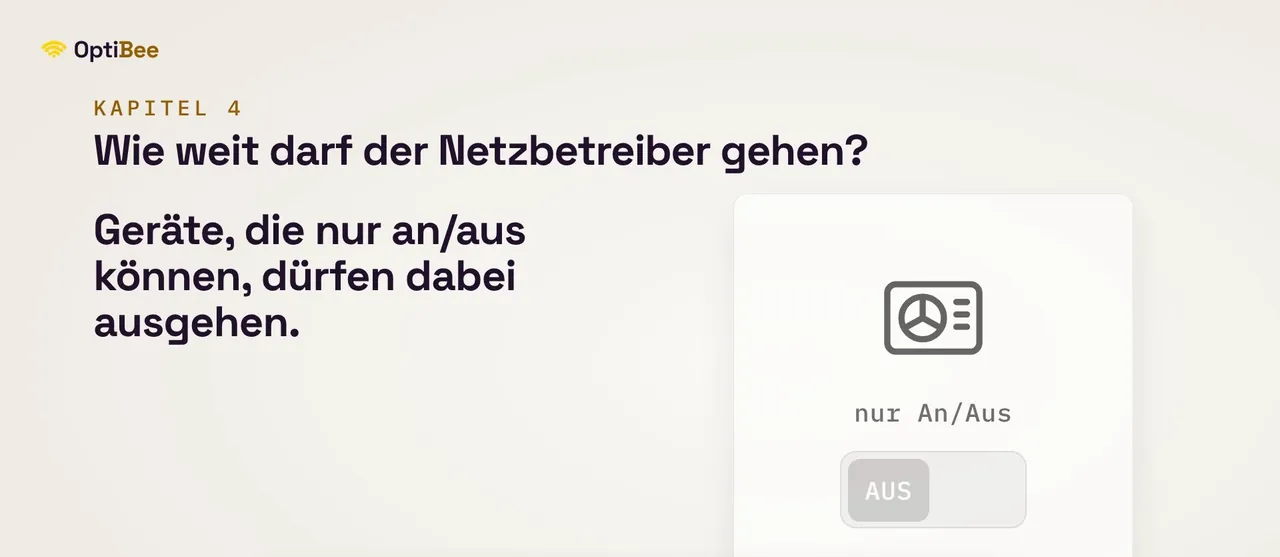
Devices that can only switch on/off may be switched off.
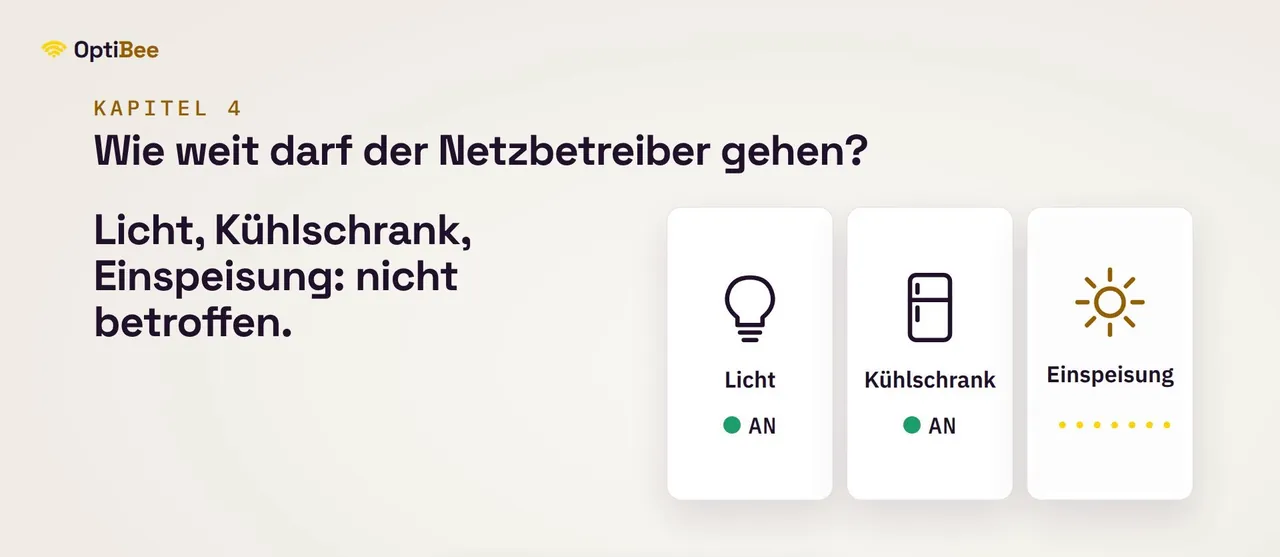
Lights and the fridge are not affected, and neither is your feed-in.
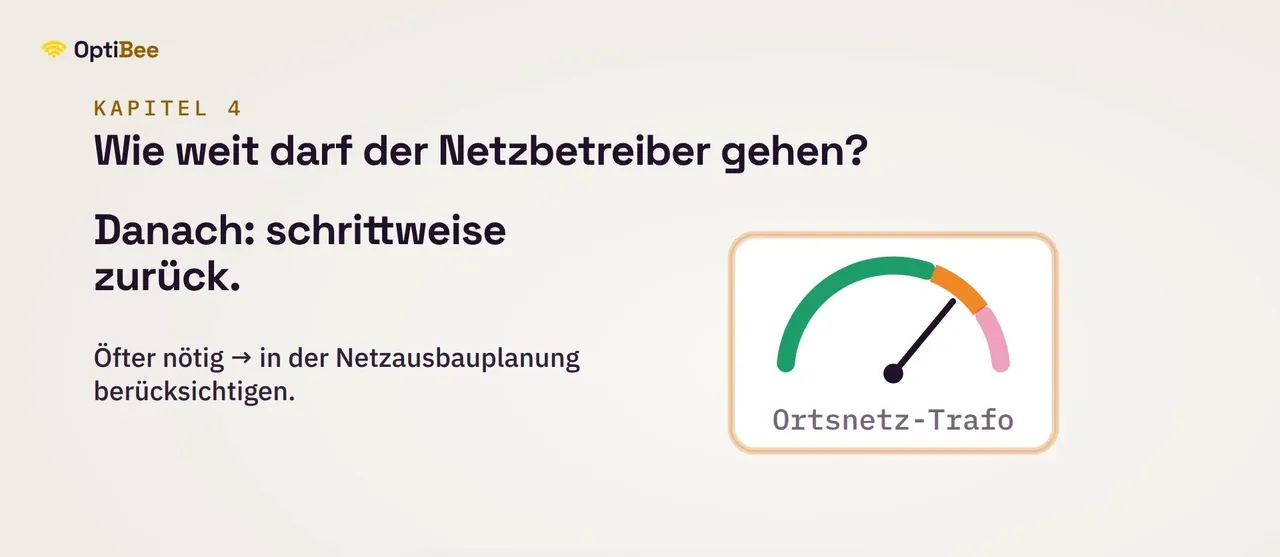
Once the situation has passed, the grid operator takes the reduction back step by step. If further interventions are to be expected, it has to take them into account in its grid expansion planning.
Source: BNetzA BK6-22-300, Annex 1, No. 4.1, 4.3, 4.5, 4.6, 6.2 and 10.5 · consumer FAQ (dimming rules, metering and control equipment)
Chapter 5: How does the command reach the building?
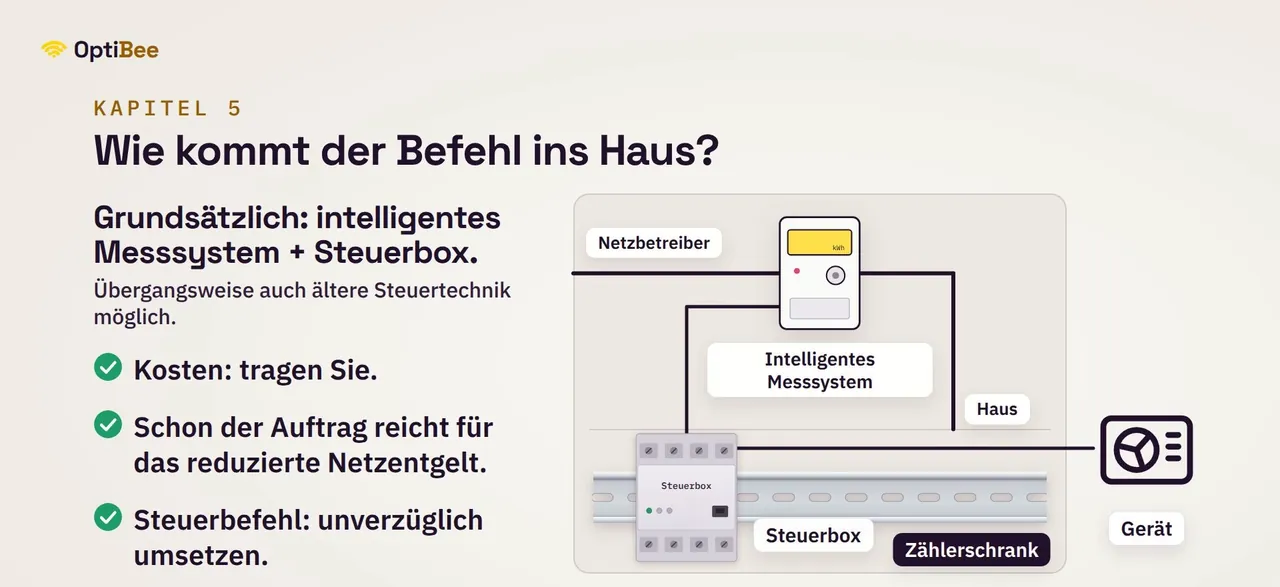
In principle through an intelligent metering system (smart meter gateway) and a Steuerbox (control box) in the meter cabinet. Older control technology is allowed for a transition period.
You order the Steuerbox from the metering point operator or the grid operator, and you pay for it. Placing the order is already enough for the reduced grid fee. When a control command (Steuerbefehl) arrives, it has to be carried out without delay.
Source: § 14a (4) EnWG · BNetzA BK6-22-300, Annex 1, No. 4.2 · consumer FAQ (metering and control equipment)
Chapter 6: Why does the installer ask about an EMS?
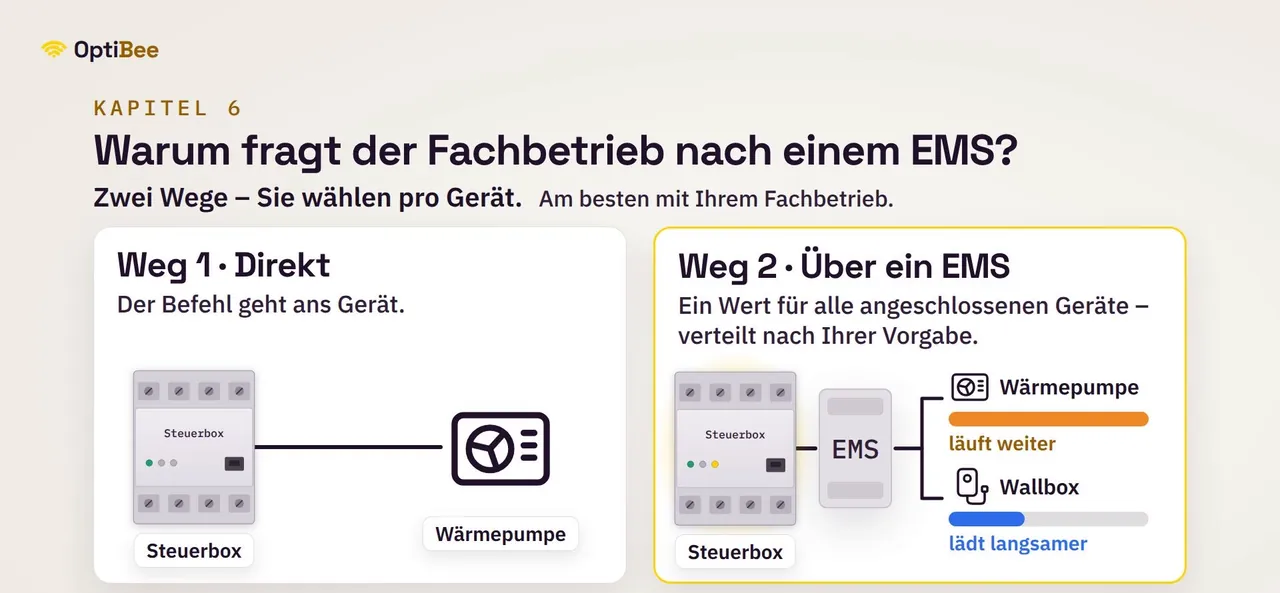
Because for every device you choose one of two paths – best together with your installer.
- Path 1 · Direct. The command goes straight to the device.
- Path 2 · Via an EMS. The command goes to an energy management system. It receives one joint value for all connected devices – and distributes it as you decide.
For example, the heat pump keeps running and the wallbox charges more slowly in the meantime.
Which path suits which case is the subject of a video of its own.
Source: BNetzA BK6-22-300, Annex 1, No. 4.4, 4.5.2 · consumer FAQ (metering and control equipment)
Chapter 7: What do you get for it?
A reduced grid fee – from the grid operator. There are three modules.
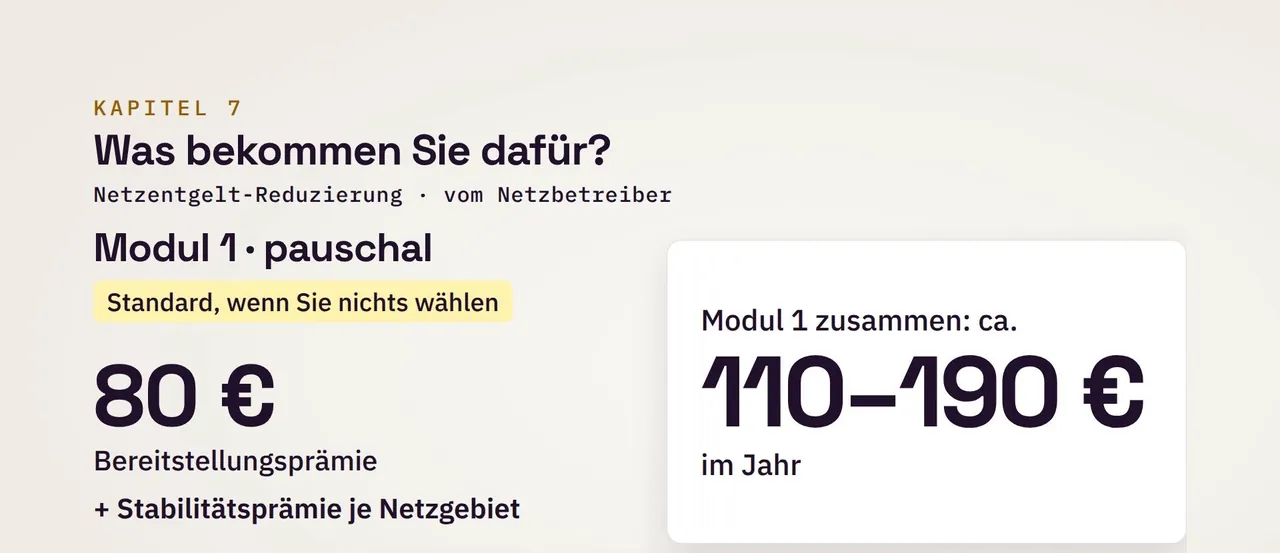
Module 1 · flat rate
The default if you choose nothing: an 80 € Bereitstellungsprämie (provision bonus) plus a Stabilitätsprämie (stability bonus) that depends on the grid area. The Bundesnetzagentur puts module 1 in total at about 110 to 190 euros a year – depending on the grid area (as of 2023).
Module 2 · percentage
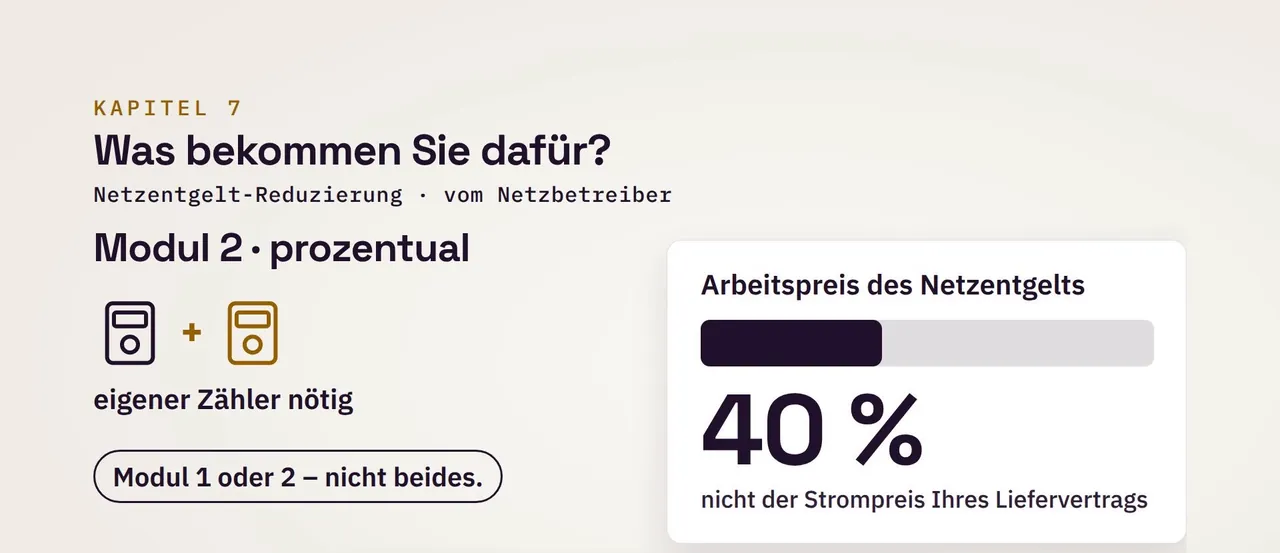
Module 2 needs a separate meter. There the energy price of the grid fee (Arbeitspreis des Netzentgelts) drops to 40 percent – the grid fee, not the price in your electricity supply contract. You choose module 1 or module 2, not both.
Module 3 · time-variable
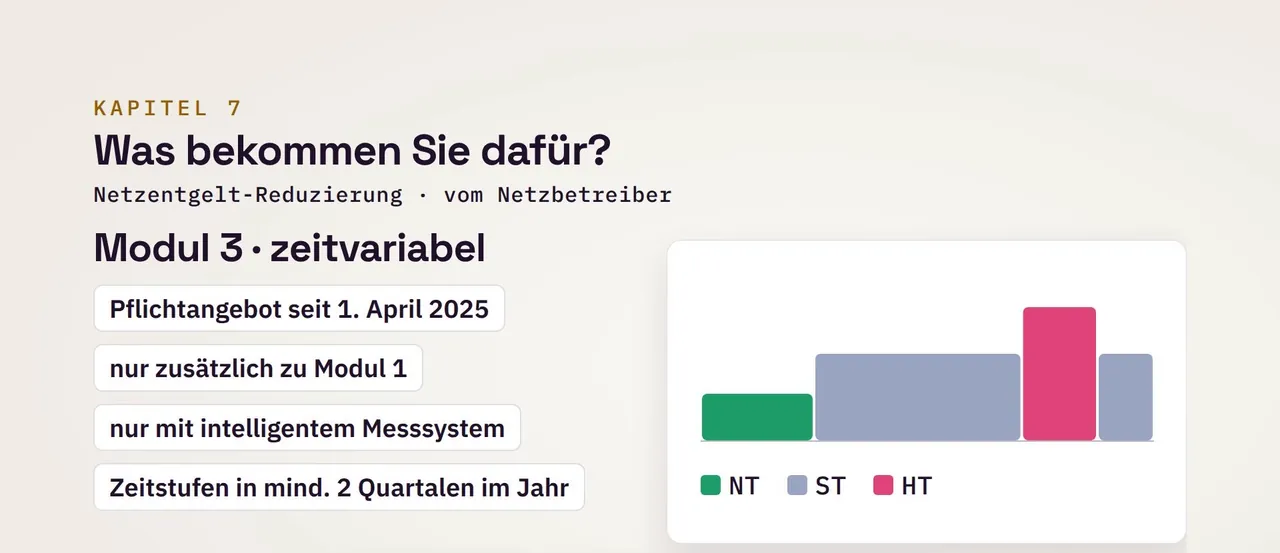
A grid fee with three time-of-use levels:
- a mandatory offer since 1 April 2025 – every grid operator has to offer it,
- only in addition to module 1,
- only with an intelligent metering system,
- the levels apply in at least two quarters of the year.
On the bill
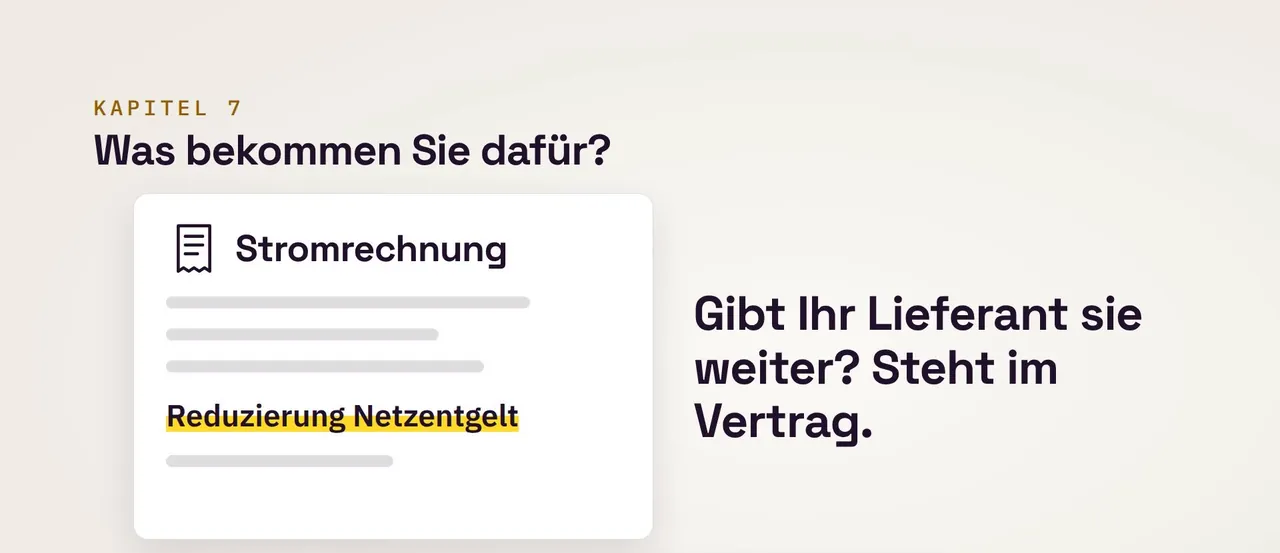
Important: the reduction is settled with your supplier and has to be shown on the electricity bill. Whether the supplier passes it on to you depends on your contract.
Source: BNetzA BK8-22/010-A, Tenor 1 to 4 · consumer FAQ (grid fee)
Chapter 8: What to do – and where OptiBee fits
Step 1: choose the control path for each device – direct or via an EMS.
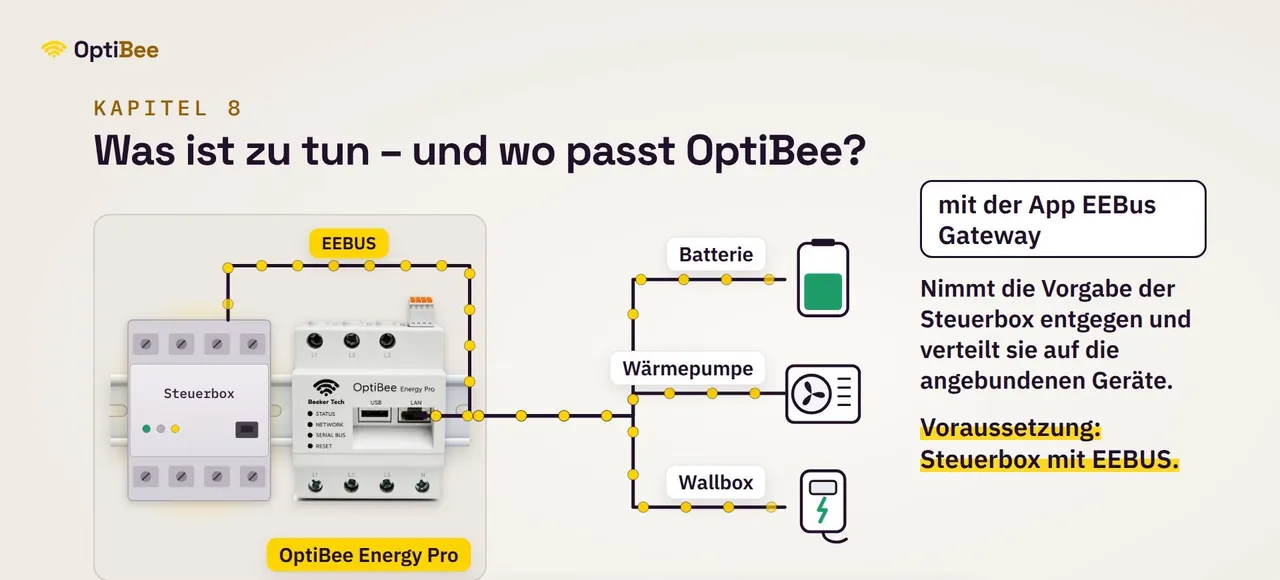
If you choose the EMS, it can be the OptiBee Energy Pro. With the app EEBus Gateway, OptiBee takes the Steuerbox's limit and distributes it over the connected devices.
Prerequisite: a Steuerbox with EEBUS. Which Steuerbox you get is decided by your metering point operator – ask about EEBUS beforehand.
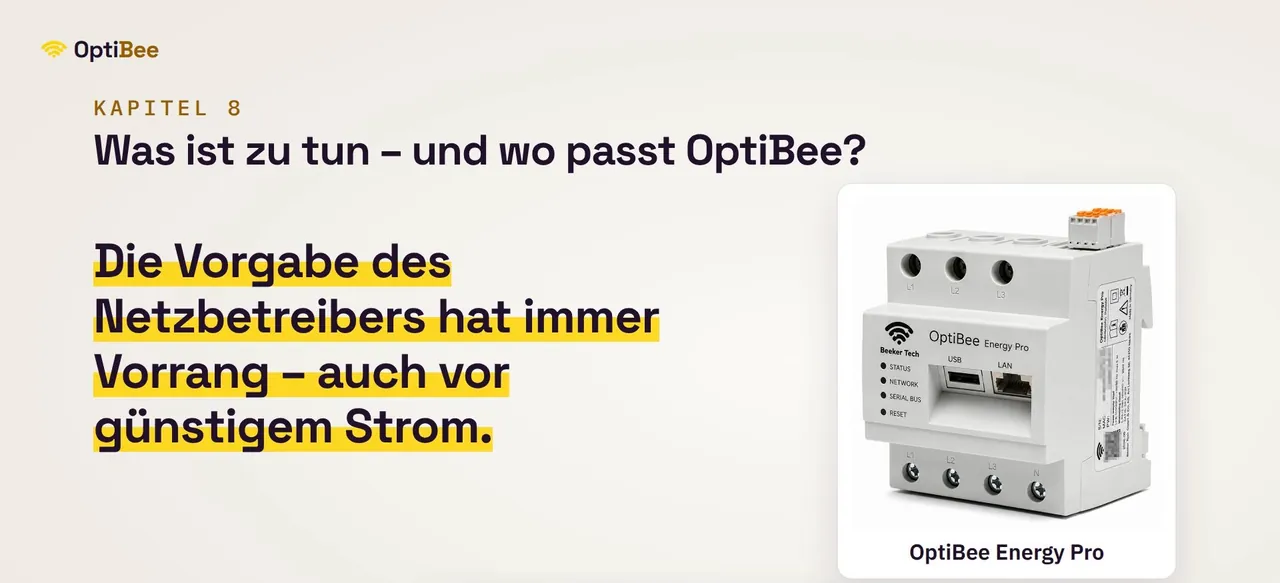
The grid operator's limit always takes precedence – even over cheap power.
Where the controller sits in the installation: Grid-side control (§14a EnWG).
Source: BNetzA, consumer FAQ (metering and control equipment, step 1) · BNetzA BK6-22-300, Annex 1, No. 4.6 · optibee.io
Chapter 9: What else is there to do?
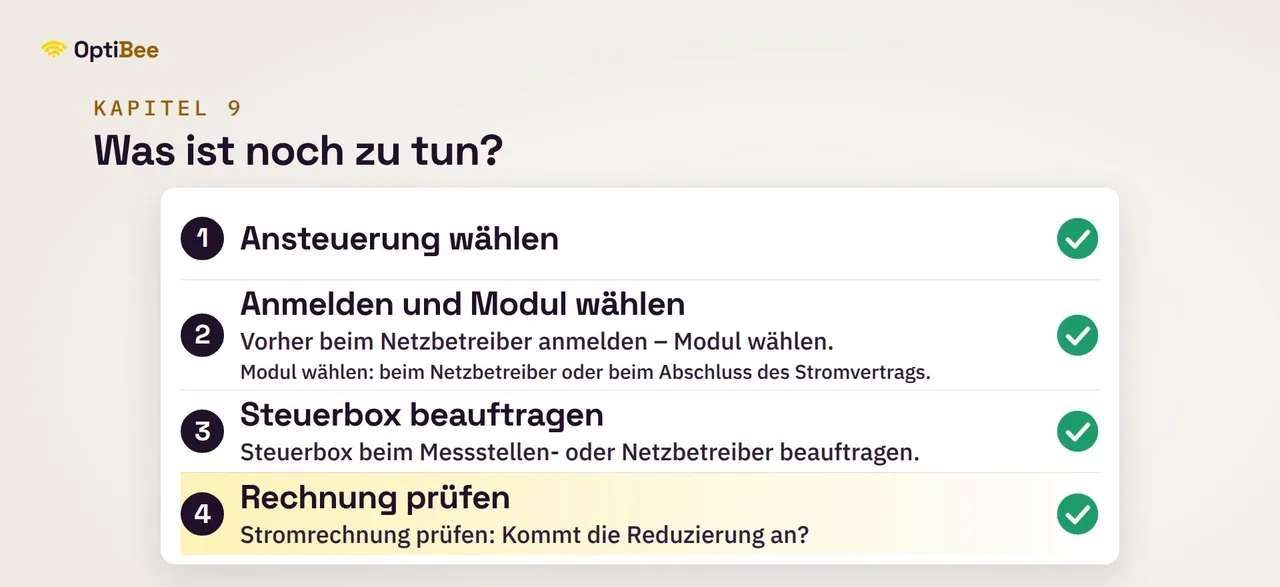
Step 2: register the device with the grid operator beforehand and choose the module at the same time. You choose the module with the grid operator or when you sign the electricity supply contract.
Step 3: order the Steuerbox – from the metering point operator or the grid operator.
Step 4: check on the electricity bill that the reduction reaches you.
Source: BNetzA, consumer FAQ (metering and control equipment, grid fee) · BK8-22/010-A, Tenor 4
In short
§ 14a means: in principle, devices are dimmed only when overload threatens – and only as far as necessary.
Source: BNetzA BK6-22-300, Annex 1, No. 4.1, 4.3, 10.5